Showing posts with label students. Show all posts

Wednesday, October 28, 2026

What We Do - Team - In News

Quantum Computing    Quantum computing is creating new ways to approach challenging problems in optimization, simulation, artificial intelligence, scientific discovery, and data analysis. Our lab works broadly across the quantum computing stack, from fundamental algorithms to methods that connect quantum processors with large-scale classical computing systems. Our research includes quantum and hybrid quantum–classical algorithms, variational quantum algorithms, quantum optimization, quantum simulation, quantum circuit design and synthesis, compilation and qubit mapping, resource-efficient computation, and rigorous theoretical analysis of quantum algorithms. We are particularly interested in scalable methods that combine quantum computing with high-performance computing and AI, including AI for quantum computing (using machine learning and generative models to design, optimize, and control quantum computations) and quantum computing for AI, where quantum methods are developed for machine learning, generative modeling, and scientific discovery. A central theme of our work is understanding how quantum, classical, AI, and HPC technologies can be combined to solve problems that are difficult for any one computational paradigm alone.

Machine Learning    Modern machine learning problems often involve enormous numbers of variables, samples, features, and interacting components, making conventional approaches computationally expensive or fundamentally difficult to optimize. Our research develops scalable machine learning and AI methods for problems involving large-scale optimization, complex structured data, graphs, and high-dimensional representations. We are particularly interested in algorithms that overcome slow convergence, combinatorial complexity, and NP-hard optimization subproblems, as well as methods that combine machine learning with optimization, scientific computing, graph algorithms, and emerging computing architectures.

AI, Literature Based Discovery and Text Mining    Scientific literature contains an enormous amount of knowledge, but many important connections remain implicit across papers, disciplines, and data sources. We develop AI systems for hypothesis generation and literature-based discovery that identify such hidden relationships and help researchers generate and prioritize new scientific hypotheses. Our work combines natural language processing, large-scale knowledge graphs, graph learning, machine learning, and large language models with experimental and curated scientific databases. A major application is biomedical and drug discovery, where our systems integrate information from millions of scientific publications and large biological and chemical datasets. We are also interested more broadly in scientific text mining, knowledge discovery, information extraction, and AI systems that can reason over large collections of heterogeneous scientific evidence.

Graph Algorithms and Network Science    Complex networks arise throughout science and engineering, including biological systems, social networks, communication systems, scientific knowledge graphs, transportation systems, and technological infrastructure. We study computational, algorithmic, modeling, and theoretical problems associated with such networks, with a particular emphasis on very large graphs. Our research includes scalable graph algorithms, community detection, graph partitioning, network optimization, anomaly and outlier detection, importance ranking, temporal and evolving networks, graph representation learning, visualization, and multilevel methods. We are especially interested in algorithms that uncover structure in networks too large or complex for conventional methods.

Combinatorial Scientific Computing    Many of the most expensive computations in science and engineering contain large discrete optimization problems hidden inside numerical algorithms. Combinatorial Scientific Computing develops graph- and hypergraph-based methods for exposing and exploiting this structure. Our work includes large-scale graph and hypergraph partitioning, ordering, coloring, clustering, task mapping, and related optimization problems. These techniques are used to improve load balancing, communication, memory locality, parallelism, and overall performance on modern high-performance computing systems. We are particularly interested in algorithms that connect combinatorial optimization with scientific computing, HPC, AI, and emerging quantum computing platforms.

Multiscale Methods    A broad range of scientific and optimization problems contain structure at multiple scales. Solving such problems directly at their finest resolution can require prohibitively large computational resources, even on modern supercomputers. We develop multiscale and multilevel algorithms that construct a hierarchy of progressively smaller representations of a problem, solve or analyze the problem at appropriate scales, and transfer information efficiently between them. These ideas originate in multigrid and multilevel scientific computing but extend naturally to graph algorithms, combinatorial optimization, machine learning, and quantum optimization. A major goal of our research is to use multiscale structure to make otherwise intractable problems computationally manageable.


Thursday, September 3, 2026

Welcome to new PhD students!

Three new PhD students are joining our lab. Welcome Brent Russon, Daniel Lebedinskiy and Steven Halley. They will be working on quantum computing for optimization and AI.


Sunday, July 12, 2026

Paper accepted in ACM Transactions in Quantum Computing

Bao Bach, Ilya Safro, Ed Younis "Efficient Compilation for Shuttling Trapped-Ion Machines via the Position Graph Architectural Abstraction", ACM Transactions in Quantum Computing, 2026

https://dl.acm.org/doi/10.1145/3831246

With the growth of quantum platforms for gate-based quantum computation, compilation holds a crucial role in deciding the success of the implementation. While there has been rich research in compilation techniques for the superconducting-qubit regime. The trapped-ion architectures, currently leading in robust quantum computations for their reliable operations, still lack competitive compilation strategies. This work introduces a unifying hardware abstraction, the “position graph”, representing various hardware architectures. With this abstraction, we model trapped-ion Quantum Charge-Coupled Device (QCCD) architectures, enabling high-quality, scalable compilation methods. Specifically, we propose scheduling algorithms called SHuttling-Aware PERmutative (SHAPER) and SHuttling-AWare (SHAW) heuristic searches to tackle the complex constraints and dynamics of trapped-ion machines, with the cooperation of state-of-the-art permutation-aware mapping. These approaches generate executable circuits and native instructions that respect the physical constraints of shuttling-based architectures. We evaluate proposed algorithms across theorized and real architectures using the position graph framework. For completeness, we also introduce a linear program of trapped-ion scheduling that yields the optimal schedules, enabling a direct comparison with our heuristics. Our algorithm can successfully compile programs for extreme architectures where prior algorithms fail. When the baseline does complete, our produced schedules are 1.45 times faster on average, with best-case speedups up to 4 times faster.

Tuesday, July 7, 2026

Seven of our papers have been accepted to IEEE Quantum Computing and Engineering 2026

Seven of our papers have been accepted to the IEEE Quantum Computing and Engineering 2026. We are looking forward to catch up with many colleagues and friends and meet new people in Toronto!

1. Graph-Conditioned Meta-Optimizer for QAOA Parameter Generation on Multiple Problem Classes

Kien Nguyen and Ilya Safro

arXiv: https://arxiv.org/abs/2604.25275

2. Scaling Qubit Mapping and Routing With Position Graph Abstraction and Memoization

Brent Russon, Bao Bach, Ed Younis, and Ilya Safro

arXiv: https://arxiv.org/abs/2605.09237

3. Constrained Counterdiabatic Quantum Approximate Optimization Algorithm for Portfolio Optimization

Jose Falla and Ilya Safro

arXiv: https://arxiv.org/abs/2605.06858

4. Warm-Starting Rank-2 MaxCut Relaxation Using Local Correlators From Depth-1 Quantum Approximate Optimization Algorithm

Bao Bach, Filip Maciejewski, and Ilya Safro

Soon on arXiv

5. Quantum Hypergraph Partitioning

Cameron Ibrahim, Bao Bach, Jad Salem, Reuben Tate, Kien Nguyen, Stephan Eidenbenz, and Ilya Safro

arXiv: https://arxiv.org/abs/2605.10623

6. Implications of Reduced DLAs for the Standard QAOA Ansatz

Jose Falla, Bao Bach, Boris Tsvelikhovskiy, and Ilya Safro

Soon on arXiv

7. QUACOD: Quantum Optimization via Coordinate Descent for Scalable Drone Scheduling

Van-Quang-Huy Nguyen, Hoang-Quan Nguyen, Samee Khan, Ilya Safro, and Khoa Luu

arXiv: https://arxiv.org/abs/2605.14001


Many thanks and congratulations to all our students and collaborators from University of California, Riverside, Los Alamos National Laboratory, Berkeley Lab, NASA - National Aeronautics and Space Administration, United States Naval Academy, University of Arkansas and Kansas State University. It's always a great pleasure working with you. 


Wednesday, February 18, 2026

Reductions of QAOA Induced by Classical Symmetries

 Super excited to share our new preprint "Reductions of QAOA Induced by Classical Symmetries: Theoretical Insights and Practical Implications" on arXiv! 

https://arxiv.org/abs/2602.16141

We explore how the performance of QAOA is determined by the structure of its dynamical Lie algebras and its connection to the expressivity and trainability. The primary objective of this work is to advance this understanding by studying the DLAs associated QAOA through the lens of symmetry reduction. Many combinatorial optimization objectives are invariant under a global bit-flip symmetry. From a classical standpoint, this symmetry allows one to fix the value of a single bit without loss of information. At first glance, this symmetry reduction appears to offer little advantage beyond a trivial reduction in problem size. One of the main contributions of this paper is to show that, at the quantum level, the situation is considerably richer. 

Huge congratulations to the students Bao Bach and Jose Falla! And special shout-out to first author Boris Tsvelikhovskiy for driving this project forward.

#QuantumComputing #QAOA #QuantumOptimization #Research #VariationalQuantumAlgorithms #Symmetry

Sunday, September 7, 2025

IEEE Quantum Computing and Engineering 2025

We had a fantastic time at IEEE Quantum Computing and Engineering (a.k.a. Quantum Week) https://lnkd.in/esWPtjHH. This is a highlight of the year that never disappoints. The conference initiated many exciting collaborations, and I’m especially proud that our lab presented or participated in five papers this time.

Special thanks to all of our amazing collaborators who made these papers possible Yuri Alexeev Marwa Farag Kyle Sherbert Karunya Shirali Sergii Strelchuk Mitchell Chiew Filip Maciejewski Khoa Luu Samee Khan. 

1. Ilya Tyagin, Marwa Farag, Kyle Sherbert, Karunya Shirali, Yuri Alexeev, Ilya Safro  "QAOA-GPT: Efficient Generation of Adaptive and Regular Quantum Approximate Optimization Algorithm Circuits"

2. Mitchell Chiew, Cameron Ibrahim, Ilya Safro, Sergii Strelchuk "Optimal fermion-qubit mappings via quadratic assignment"

3. Bao Bach, Filip Maciejewski, Ilya Safro "Solving Large-Scale QUBO with Transferred Parameters from Multilevel QAOA of low depth"

4. Kien Nguyen, Bao Bach, Ilya Safro "Cross-Problem Parameter Transfer in Quantum Approximate Optimization Algorithm: A Machine Learning Approach"

5. Hoang-Quan Nguyen, Xuan-Bac Nguyen, Sankalp Pandey, Samee U. Khan, Ilya Safro, Khoa Luu

 "QMoE: A Quantum Mixture of Experts Framework for Scalable Quantum Neural Networks"

What made it even more special was reconnecting with our former students Ruslan Shaydulin and Joey Xiaoyuan Liu, now leading experts in quantum computing. Seeing their impact on the field is both exciting and inspiring.

Looking forward to next year’s Quantum Week in Toronto!


#QuantumComputing #QAOA #QuantumOptimization #IEEEQCE #QuantumEngineering #HybridAlgorithms #Research #MachineLearning #QML 


Saturday, May 10, 2025

Two new papers in quantum computing and graph algorithms

We are happy to announce two new quantum computing papers from our group! I am particularly excited because both papers are direct applications of combinatorial scientific computing methods in the quantum computing domain.

The first, led by Hanjing Xu from Purdue University, presents a novel approach to transferring QAOA parameters for Maximum Independent Set problem using graph attention networks. This is a step toward building distributed hybrid quantum-classical algorithms, where large graph optimization problems are divided into smaller, quantum-solvable pieces and solved across quantum and classical systems. The approach achieves competitive performance and shows a promising direction for scalable quantum optimization.

Check our paper at https://arxiv.org/abs/2504.21135


The second paper, led by Mitchell Chiew from University of Cambridge and Cameron Ibrahim from University of Delaware, introduces optimization strategies for fermion-qubit mappings, a foundational step in simulating fermionic systems on quantum computers. By framing the problem as a quadratic assignment and strategically adding ancilla qubits, we achieve very good reductions to existing mappings, lowering the resource demands for quantum simulations. 

Check our paper at https://arxiv.org/abs/2504.21636


These papers couldn’t have happened without the great collaboration with Joey Xiaoyuan Liu from Fujitsu Research USA, Alex Pothen from Purdue University, and Sergii Strelchuk from the University of Oxford - thank you!

Wednesday, April 30, 2025

QAOA-GPT: Efficient Generation of Adaptive and Regular Quantum Approximate Optimization Algorithm Circuits

Our new paper "QAOA-GPT: Efficient Generation of Adaptive and Regular Quantum Approximate Optimization Algorithm Circuits" is now out! We introduce QAOA-GPT, a generative AI framework that uses GPT-style model to synthesize quantum circuits for solving combinatorial optimization problems and demonstrate it on MaxCut. Unlike traditional quantum approximate optimization algorithms and adaptive approaches, which rely on slow, iterative optimization, QAOA-GPT generates full circuits in a single forward pass, greatly improving scalability and efficiency. Importantly, this approach does not rely on prompt engineering or fine-tuning—the model is trained entirely from scratch using a custom circuit representation and graph-conditioned architecture.

It was a great pleasure collaborating on this project with an amazing team Marwa Farag and Yuri Alexeev from NVIDIA, and Kyle Sherbert and Karunya Shirali from Virginia Tech - thank you all for making this project a great experience! And huge congratulations to PhD student Ilya Tyagin for leading this work!

Check our paper at https://arxiv.org/abs/2504.16350


Friday, April 18, 2025

Cross-problem parameter transferability in Quantum Approximate Optimization Algorithm

Our latest work on making Quantum Approximate Optimization Algorithm more efficient through parameter transferability. Now it is the transferability across combinatorial optimization problems. Imagine a scenario where we have pre-trained QAOA parameters on a large collection of known optimization problems during the preprocessing. But then, a new problem class emerges, perhaps less studied or previously unknown. Should we invest substantial computational resources to re-optimize from scratch? 

We propose a graph neural network-based retrieval framework that learns graph embeddings and predicts transferable QAOA parameter sets optimized for MaxCut to accelerate convergence on Maximum Independent Set. Congratulations to PhD students Kien Nguyen and Bao Bach!

Check our paper at https://arxiv.org/abs/2504.10733


Saturday, September 21, 2024

Best Paper Award in Quantum Algorithms and IEEE Quantum Week

Our team had an amazing time at IEEE Quantum Computing and Engineering 2024 (aka IEEE Quantum Week) in Montreal, where we were honored to receive the Best Paper in Quantum Applications Award for the paper "MLQAOA: Graph Learning Accelerated Hybrid Quantum-Classical Multilevel QAOA"! The conference was packed with excellent talks, workshops, tutorials and panels. 

It was also wonderful to catch up with our lab’s alumni, the Algorithms and Computational Science Lab legends Ankit Kulshrestha Joey Xiaoyuan Liu Ruslan Shaydulin, and see their success in the field. Graduate students Bao Bach and Cameron Ibrahim gave excellent talks on their papers. Big thanks to everyone who made this event such a success. This year there were over 1,550 participants from universities, national labs, and industry. Looking forward to even better event next year in Albuquerque, NM! 

#IEEEQuantum #QCE24 #QuantumComputing #QuantumWeek #IEEE #QuantumWeek2024


Thursday, December 14, 2023

Ankit Kulshrestha's PhD Defense

Congratulations to Dr. Ankit Kulshrestha for successfully defending his Ph.D. thesis "A Machine Learning Approach To Improve Scalability and Robustness of Variational Quantum Circuits"! Ankit will join the quantum computing research group at Fujitsu Research USA.


Friday, September 30, 2022

Optimal Contraction Trees for Tensor Network Quantum Circuit Simulation

We are excited to announce that our paper received the best student paper award at #IEEE High Performance Extreme Computing #HPEC2022! Leading student is Cameron Ibrahim. Congratulations to all!

Cameron Ibrahim, Danylo Lykov, Zichang He, Yuri Alexeev, Ilya Safro "Constructing Optimal Contraction Trees for Tensor Network Quantum Circuit Simulation", 2022, preprint at https://arxiv.org/abs/2209.02895

One of the key problems in tensor network based quantum circuit simulation is the construction of a contraction tree which minimizes the cost of the simulation, where the cost can be expressed in the number of operations as a proxy for the simulation running time. This same problem arises in a variety of application areas, such as combinatorial scientific computing, marginalization in probabilistic graphical models, and solving constraint satisfaction problems. In this paper, we reduce the computationally hard portion of this problem to one of graph linear ordering, and demonstrate how existing approaches in this area can be utilized to achieve results up to several orders of magnitude better than existing state of the art methods for the same running time. To do so, we introduce a novel polynomial time algorithm for constructing an optimal contraction tree from a given order. Furthermore, we introduce a fast and high quality linear ordering solver, and demonstrate its applicability as a heuristic for providing orderings for contraction trees. Finally, we compare our solver with competing methods for constructing contraction trees in quantum circuit simulation on a collection of randomly generated Quantum Approximate Optimization Algorithm Max Cut circuits and show that our method achieves superior results on a majority of tested quantum circuits.


Monday, May 23, 2022

Graduate Student Achievement Award

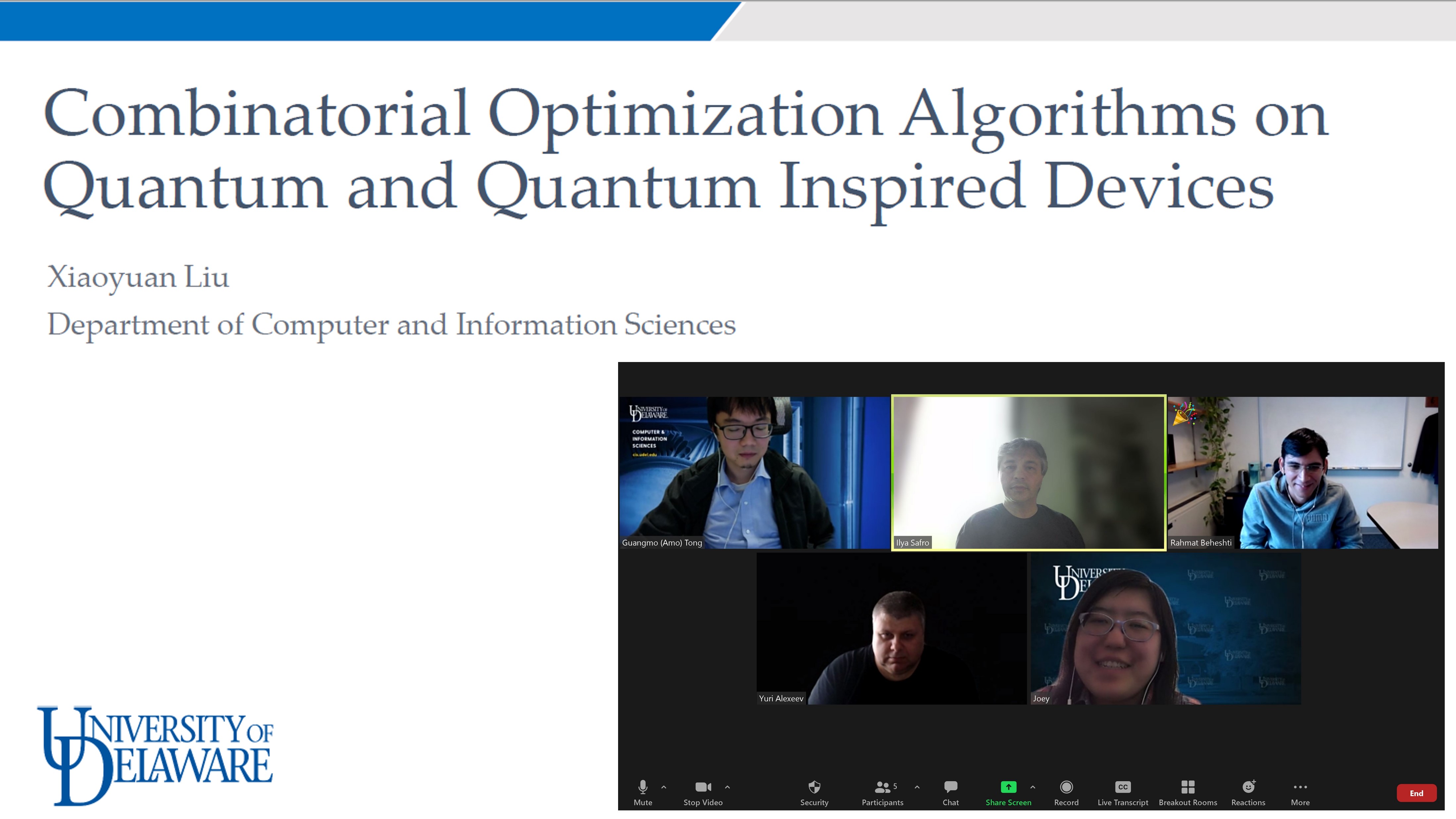
Congratulations to my former PhD student Xiaoyuan Joey Liu for winning Frank A. Pehrson Graduate Student Achievement Award! Her thesis is titled "Combinatorial Optimization Algorithms on Quantum and Quantum Inspired Devices". Xiaoyuan is now a research scientist at Fujitsu working in the area of quantum computing. This award is given to a computer science graduate student in recognition of outstanding performance, and potential for future significant contribution to the field of computer science.


Friday, December 10, 2021

Congratulations to Dr. Joey!

Congratulations to Dr. Xiaoyuan Joey Liu for successfully defending her Ph.D. thesis "Combinatorial Optimization Algorithms on Quantum and Quantum-inspired Devices"! Joey will join quantum computing research group at Fujitsu Research USA.


Monday, August 30, 2021

Tutorial on the quantum approximate optimization algorithm, its applications and simulation

We recorded this tutorial for IEEE International Conference on Quantum Computing and Engineering (QCE) 2020. This tutorial consists of four parts:

  1. QAOA theory and quantum computing basics
  2. Hands on example of QAOA and MaxCut
  3. Introduction to problem decomposition and solving large-scale problems with QAOA
  4. Tensor networks and simulation of QAOA with classical computers

Wednesday, June 10, 2020

PhD thesis defense

Congratulations to Dr. Ruslan Shaydulin for successfully defending his Ph.D. thesis "Quantum and Classical Multilevel Algorithms for (Hyper)Graphs"! Ruslan will join Argonne National Lab with  MGM fellowship in August. This is the second defense in our lab this week!


Monday, June 8, 2020

PhD thesis defense

Congratulations to Dr. Ehsan Sadrfaridpour for successfully defending his Ph.D. thesis "Fast Machine Learning Algorithms for Massive Datasets with Applications in Biomedical Domain"! Ehsan will join Lowe's data science team this summer.


Tuesday, April 14, 2020

Thursday, March 26, 2020

PhD thesis defense

Congratulations to Dr. Justin Sybrandt for successfully defending his Ph.D. thesis "Exploiting Latent Features of Text and Graphs"! Justin will join Google Brain this summer.


Friday, January 17, 2020

Congratulations to PhD student Ruslan Shaydulin

Congratulations to PhD student Ruslan Shaydulin, advised by Dr. Ilya Safro, for receiving 2020 Maria Goeppert Mayer fellowship for postdoctoral studies at Argonne National Lab. Ruslan will start in Fall 2020. He was selected among many candidates from top schools and different disciplines.


What We Do - Team - In News

Quantum Computing     Quantum computing is creating new ways to approach challenging problems in optimization, simulation, artificial intell...